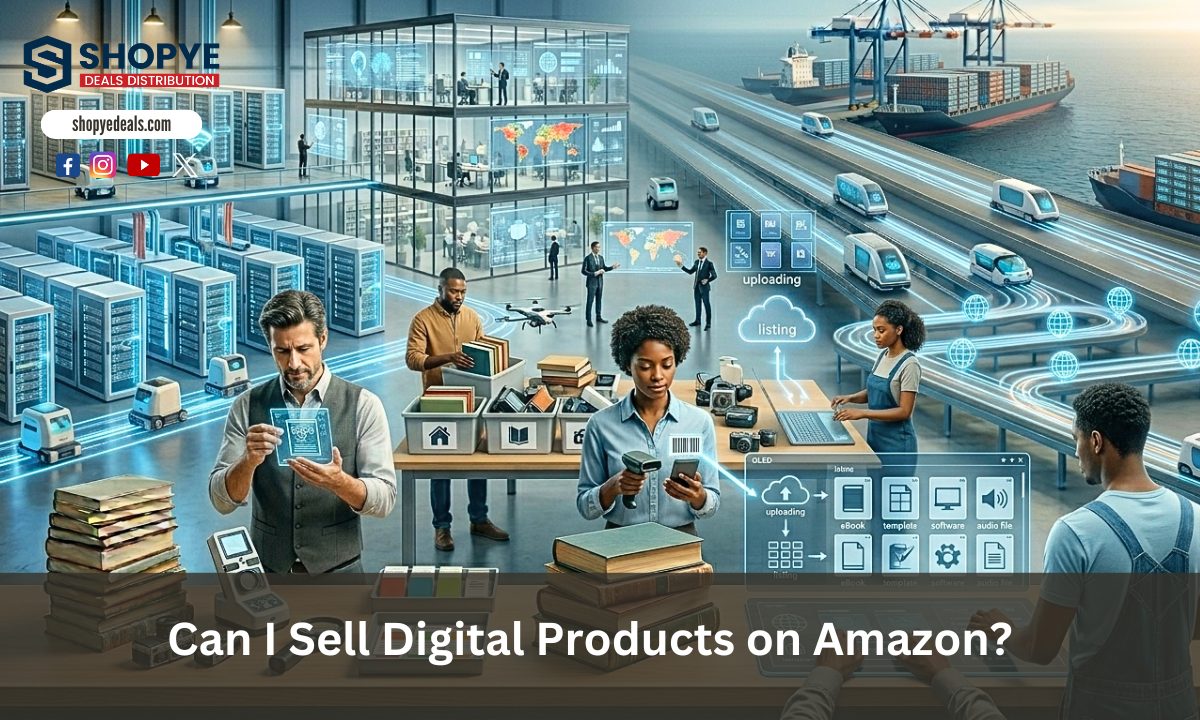
Have you created an ebook, printable, template, or digital guide and wondered whether you can turn it into a steady source of income? If you’re asking, “Can I Sell Digital Products on Amazon?” you’re asking a question that many entrepreneurs, creators, and side hustlers across the USA want answered.
The problem is that Amazon is known mainly for physical products, which makes many creators assume digital products are not allowed or are difficult to sell. As a result, they miss opportunities to reach one of the world’s largest online marketplaces and millions of potential customers.
The good news is that Amazon offers several ways to sell certain types of digital content, including ebooks and other digital assets through specific programs and platforms. With digital products, you can often avoid inventory costs, shipping expenses, and storage fees that come with physical goods.
In fact, digital commerce continues to grow rapidly in the United States as more consumers prefer instant access to content and downloadable products. In this guide, you’ll learn how digital product sales work on Amazon, which digital products are allowed, the available selling options, and how to start generating revenue from your digital creations.
Can You Sell Digital Products on Amazon?
The direct answer is yes, but not in the standard Seller Central marketplace.
You cannot upload digital files and sell them as direct downloads. Amazon does not support open file delivery such as PDFs, ZIP files, or external download links. Instead, digital products must go through specific Amazon systems.
This creates two clear categories:
Allowed digital selling routes
Not allowed direct selling methods
Understanding this difference is the foundation of compliance and long-term success.
Amazon’s Controlled Digital Ecosystems
Amazon splits digital products into structured systems. Each system has its own rules, formats, and distribution logic.
Kindle Direct Publishing (KDP)
KDP is used for written content such as ebooks, journals, and low-content books. Even PDFs must be converted into structured publishing formats.
Amazon uses NLP-based keyword indexing inside KDP. It scans your title, description, and keywords to understand your content. Then it applies semantic matching to “auto-find” your book and show it to relevant readers. This system is based on keyword indexing and category relevance.
Amazon Appstore
The App Store is used for software, tools, and mobile applications. You cannot sell APK files as direct downloads.
Instead, you must publish through a developer system where Amazon reviews your app before approval. This ensures security, performance, and compliance. Once approved, your app becomes part of Amazon’s controlled distribution system.
Merch on Demand
Merch on Demand is designed for graphic designs and digital artwork. You cannot sell image files directly.
Instead, you upload your design, and Amazon converts it into physical products such as t-shirts or hoodies. Your digital file is never delivered to the customer. It is only used for production. This system turns digital assets into physical goods instead of file downloads.
Audible / ACX
Audible is used for audiobooks and spoken content. You must record or produce audio content and publish it through ACX.
Amazon reviews and processes your audio before distribution. Users then stream or purchase the audiobook inside Amazon’s audio ecosystem. Again, there is no direct file delivery to customers.
Key Restrictions You Must Follow

Amazon has strict rules for digital products. These restrictions are enforced by automated systems and NLP-based monitoring tools.
You cannot sell direct file downloads. You cannot sell PDFs as standalone digital products. You cannot include external links such as Google Drive or Dropbox. You cannot send license keys or activation codes through messaging systems.
These rules exist because Amazon controls all digital delivery through internal systems. Its policy enforcement engine scans listings, keywords, and user communication to detect violations.
If you break these rules, Amazon can remove your listings or restrict your account. In some cases, automated systems take action before manual review even happens.
How Visibility Works on Amazon
Amazon visibility depends on multiple NLP-driven factors.
Keyword indexing is the first layer. Amazon scans your listing and stores it in its search database. Backend search terms add extra hidden keywords that improve matching. Category relevance ensures your product is placed in the correct ecosystem. Title optimization acts as a strong ranking signal for search visibility.
Amazon also uses an “auto-find” system. This means it automatically surfaces listings based on semantic keyword matching and buyer behavior signals. It analyzes how users search, click, and purchase similar products, then adjusts visibility accordingly.
Common Mistakes to Avoid
Many beginners fail because they misunderstand Amazon’s structure.
Trying to sell direct download links is the most common mistake. Uploading PDFs incorrectly in Seller Central is another issue. Ignoring platform-specific rules often leads to rejection. Many people also treat Amazon like an open digital marketplace, which it is not. Poor keyword optimization further reduces visibility and search ranking.
Practical Execution Strategy
To sell digital products successfully, you must follow a structured process.
First, identify your product type, such as an ebook, app, design, or audio. Then match it to the correct Amazon platform. Next, convert your file into the required format, such as EPUB, APK, PNG, or MP3. After that, publish through the official channel, such as KDP or the App Store.
Finally, optimize your listing using NLP-based keyword strategies. This improves indexing and increases visibility in search results.
Key Insight
Amazon allows digital product monetization, but only through structured ecosystems, not open marketplace uploads. Your success depends on correct platform selection, strict compliance, and proper keyword optimization.
Amazon uses automated classification systems to auto-find and route products into the correct categories. This means your product visibility is shaped by both your content and the platform’s NLP systems.
Conclusion
Amazon is not an open digital marketplace. It is a controlled digital distribution network. Every digital product must pass through a structured ecosystem such as KDP, Appstore, Merch on Demand, or Audible.
Success depends on how well you align your product with these systems. Compliance is mandatory, and visibility depends on NLP-based keyword indexing and automated classification.
In the end, the system is platform-driven, not seller-driven. Your role is to follow the structure, match the correct ecosystem, and optimize your content for Amazon’s automated discovery systems.
FAQs
Can I sell digital products directly on Amazon?
No, you must use Amazon’s official ecosystems like KDP, Appstore, or Merch on Demand.
Why doesn’t Amazon allow digital file downloads?
Because it uses controlled delivery systems to prevent misuse, piracy, and policy violations.
What is the best way to sell eBooks on Amazon?
Through Kindle Direct Publishing using proper formatting and keyword optimization.
Can I sell PDFs on Amazon KDP?
You can use PDF content only if it is converted into a proper book format, not as a direct download.
How does Amazon classify digital products automatically?
Through NLP-based keyword indexing, semantic mapping, category matching, and buyer behavior analysis.