
Quick buyer overview
This long-form guide is now organized for faster scanning. Jump to the section you need, search other Shopye articles, or continue reading the full wholesale breakdown.
- Compare MOQ, pricing, and supplier reliability before ordering.
- Use the section index to jump straight to price, supplier, or FAQ details.
- Search more wholesale guides without leaving the article page.
You lower your price to win the Buy Box, but suddenly your supplier sends a warning. Your listing looks fine, yet you are told you broke a pricing rule you did not even know existed. This is where many sellers get confused and lose control over their business.
So, what is a map price in Amazon FBA, and why does it matter so much for your listings? If you sell in the USA marketplace, you are already competing in a broader space. In the USA marketplace, MAP price changes happen fast.
Here is a fact you should know. Many brands in the US use MAP policies to control how low their products can be advertised. Even on platforms like Amazon, use MAP policies. This means your pricing strategy is not just about competition. It is also about compliance.
In this guide, you will learn how MAP pricing works. Why it affects your Buy Box chances, and how you can stay safe while still making a profit.
MAP Price on Amazon FBA
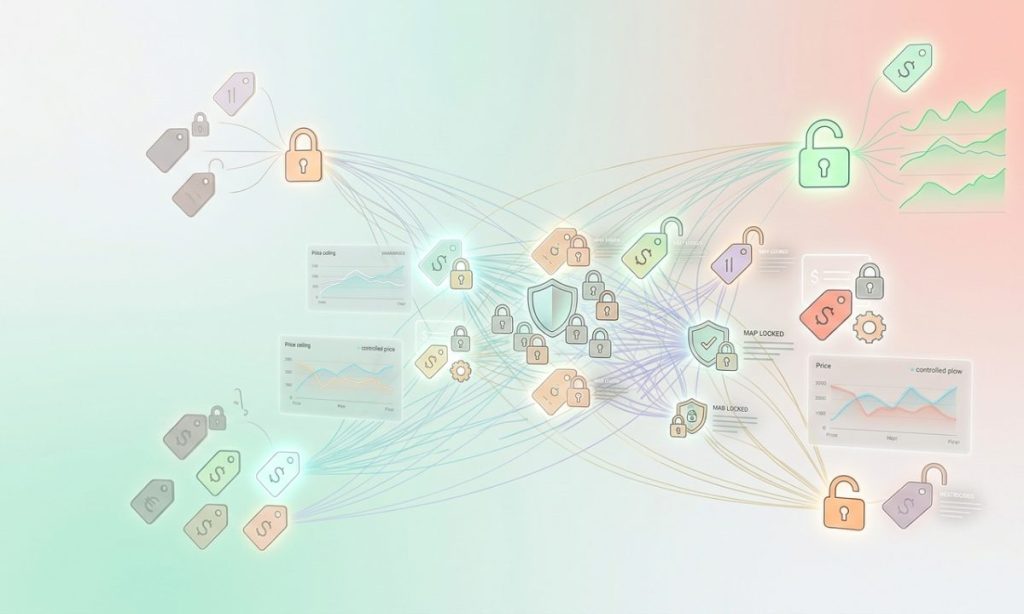
When you sell on Amazon, pricing is not always in your full control. Many sellers ask what MAP pricing on Amazon is and how it affects their listings. MAP stands for Minimum Advertised Price. It means the lowest price you are allowed to show publicly for a product.
In simple words, the minimum advertised price Amazon meaning is the price floor set by a brand. You cannot display a price lower than this on your product page. This is why MAP pricing explained is not about what you sell at, but what you show to customers.
How MAP Pricing Works on Amazon FBA
To understand how MAP pricing works, you need to look at how brands control pricing. Brands set MAP as a unilateral policy. This means they decide the rules on their own. You do not negotiate it as a seller.
In Amazon FBA, most sellers are third-party sellers. As a 3P seller, you buy products from Amazon FBA suppliers and resell them. When you agree to work with a brand, you also agree to follow its MAP policy.
Amazon MAP policy rules apply only to the public listing price. This means the price shown on the product page must follow MAP. However, the actual selling price can be different in some cases.
For example, you may use:
- Coupons
- Promo codes
- Cart discounts
These methods reduce the final price without changing the advertised price. This is why it’s important to understand MAP pricing in compliance.
MAP vs MSRP: What Is the Difference?
Many sellers confuse MAP with MSRP. You need to understand both clearly.
MSRP means Manufacturer Suggested Retail Price. It is a recommended price given by the brand. You are not forced to follow it.
MAP, on the other hand, is stricter. It controls the lowest price you can advertise. If you go below MAP, you may face action from the brand.
In the MAP vs MSRP Amazon comparison:
- MSRP is a suggestion
- MAP is a restriction
For example, a product may have an MSRP of $30 and a MAP of $22. You can sell at $25 or $23, but you cannot advertise below $22.
Why MAP Pricing Matters for Amazon FBA Sellers

MAP pricing is important because it directly affects your competition. On Amazon, sellers try to win the Buy Box. Many reduce prices to get more sales.
This creates an Amazon price competition problem. When one seller drops the price, others follow. This leads to price wars. MAP helps control this situation. It protects your profit margin and prevents the market from going too low. It also helps brands maintain value. If prices drop too much, customers may think the product is low quality. So MAP helps protect brand pricing on Amazon.
Another benefit is customer trust. When prices stay consistent, buyers feel more confident. They do not see large price differences between sellers.
Does Amazon Enforce MAP Pricing?
One important thing you must know is that Amazon does not enforce MAP. Many sellers ask does Amazon enforce MAP, and the answer is no.
Amazon follows its own rules, such as the Fair Pricing Policy. This policy is different from MAP. It focuses on preventing unfair or extreme pricing. This is known as Amazon neutrality. Amazon does not take part in MAP enforcement. It leaves this responsibility to brands.
So if there is a violation, the brand will take action, not Amazon.
What Happens If You Violate MAP on Amazon?
A MAP violation happens when you show a price lower than the allowed limit. This can happen in two ways.
First is a direct price drop. You list your product below the MAP. This is a clear violation.
Second is hidden discounts. Sometimes coupons or promotions can also break rules. They do so by reducing the visible price.
When a violation happens, brands may take action. Common MAP policy violation consequences include:
- Warning emails
- Cease and desist notices
- Cutting off the supply
For FBA sellers, this is a serious risk. If your supplier stops working with you, your business can suffer.
How to Stay Compliant with MAP Pricing
To stay safe, you need a clear strategy. First, monitor your listings regularly. Do not rely only on automation.
Second, set minimum price rules in your repricer. This prevents accidental violations.
Third, communicate with your suppliers. Make sure you understand their MAP policy clearly.
Also, avoid public price drops below MAP. Use safe methods like coupons if allowed.
How to Report a MAP Violator on Amazon
Brands take MAP seriously. They often track sellers who break rules. If you notice a violation, you can report a MAP violation to Amazon through the brand or supplier. Amazon itself has a limited role in this process.
First, identify the violation clearly. Check the advertised price. Then contact the brand or distributor. Provide proof of the price issue. This is how most Amazon seller pricing complaint cases are handled.
Is MAP Pricing Legal in the USA?
Many sellers ask whether MAP pricing is legal in the US. The answer is yes, but under certain conditions.
MAP is legal because it is a unilateral policy. The brand sets the rules on its own. It is different from price fixing. In price fixing, multiple sellers agree on prices, which is illegal. This makes the minimum advertised price legality clear and safe when used correctly.
Common MAP Pricing Mistakes You Should Avoid
Many sellers make simple mistakes. One common error is confusing MAP with the minimum selling price. They are not the same.
Another mistake is ignoring hidden discounts. Coupons can also create issues if not used carefully. Some sellers also do not control their repricer tools. This leads to automatic violations.
Finally, competing only on price is risky. You should focus on value, service, and listing quality. Avoiding these MAP pricing mistakes helps you reduce Amazon seller pricing errors.
Conclusion
MAP pricing is an important part of selling on Amazon. It helps control pricing, protect brands, and reduce price wars. You need to understand the difference between Amazon rules and brand rules. Amazon controls the marketplace, but brands control MAP.
If you focus only on lowering prices, you may lose long-term profit. A better approach is to balance compliance and competition.
FAQs
What is MAP pricing in simple words?
It is the lowest price you can show publicly for a product.
Can you sell below MAP on Amazon?
You can sometimes sell lower using discounts, but you cannot advertise below MAP.
Can Amazon suspend you for MAP violation?
No, Amazon does not enforce MAP. But brands may take action.
How do brands enforce MAP pricing?
They send warnings or stop supplying products to sellers who break rules.
What is the difference between MAP and Amazon’s pricing policy?
MAP is set by brands, while Amazon’s pricing policy is controlled by Amazon itself.
More wholesale article previews
Use these related guides to compare brands, categories, and supplier options before making your next wholesale order.
 Outdoor Cap Wholesale: A Complete Guide to Buying Wholesale Outdoor Caps The demand for outdoor cap wholesale products continues to make caps an attractive category for retailers, sports stores,… Read guide →
 Where to Buy Anker Wholesale: Sourcing Guide for Electronics and Mobile Resellers Every device a customer owns is a charging problem waiting to happen, and Anker built its name on… Read guide →
 Where to Buy Owala Wholesale: Sourcing Guide for Sporting Goods and Gift Resellers The reusable water bottle went from commodity to cultural object in under a decade, and Owala rode that… Read guide →
 Where to Buy SadoTech Wholesale: Sourcing Guide for Home Improvement Resellers The wireless doorbell is the rare home product that sells itself in one sentence: no wiring, installs in… Read guide →
 Where to Buy Sennheiser Wholesale: Sourcing Guide for Music and AV Resellers Pro audio is a category where the name on the microphone decides the sale before the customer hears… Read guide →
 Where to Buy CLIF Bar Wholesale: Sourcing Guide for Grocery and Outdoor Resellers Energy bars are the rare grocery category that sells in the checkout lane, the gym bag, the trailhead,… Read guide →